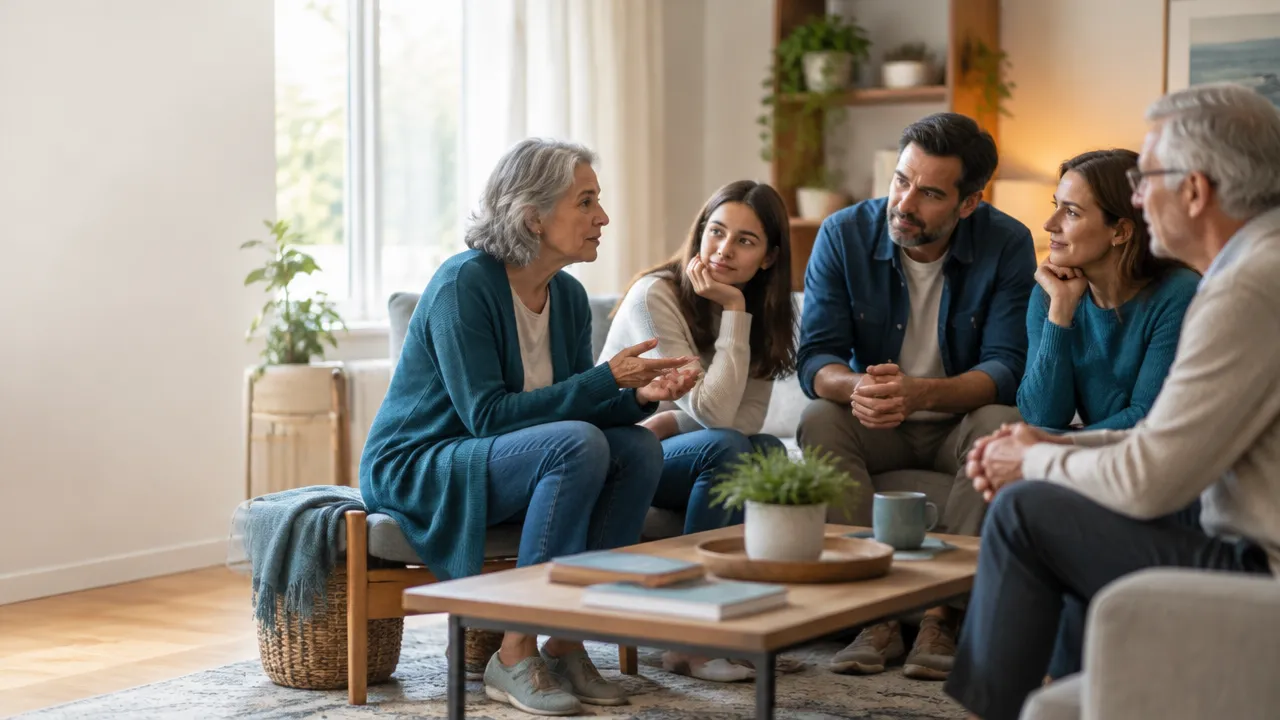

Group dynamics are the patterns of influence that emerge when people interact, and they can change what individuals say, decide, and do. For teams, families, and community groups, understanding those patterns is more useful than labeling one person as “the problem.” Notice what the group rewards, discourages, and leaves unspoken.
Key insights for understanding behavior in groups
- People often adjust their behavior in response to belonging, uncertainty, status, and the reactions of others.
- Roles and norms form through everyday interactions, whether or not anyone has formally defined them.
- Agreement is not proof of shared understanding; silence may reflect caution, confusion, or pressure.
- Small changes to turn-taking, decision rules, and responses to dissent can shift the group’s pattern.
Group behavior is shaped by repeated interactions, not personality alone
A group pattern is a loop: someone acts, others interpret that behavior, and their responses influence what happens next. A person who speaks often may be seen as the natural leader, while a quieter member may be overlooked, even when they have relevant knowledge.
Four practical lenses help reveal the loop: roles, norms, status, and communication. These are useful ways to observe a group, not a fixed or universal classification of group types.
- Roles: Who organizes, decides, challenges, supports, or carries out the work?
- Norms: What behaviors earn approval, and which ones lead to discomfort or exclusion?
- Status: Whose opinions receive attention, including when formal authority is absent?
- Communication: Who speaks, who gets interrupted, and how does information travel?
The American Psychological Association explains that people may conform to fit in or follow others they believe have more expertise. Its overview of social influence also describes group processes such as social loafing and groupthink. These ideas help explain why the same person may act differently alone and in a group.
When discussion appears harmonious but decisions keep stalling, gaps in group self-awareness may help explain what is happening beneath the surface.
Unspoken norms can change who contributes and what gets decided
Norms grow from repeated signals, not just written rules. If a team praises speed but reacts defensively to questions, members may learn to hide uncertainty and avoid raising risks. If a family resolves tension by changing the subject, everyone may adapt by withholding concerns.
Consider a planning meeting where the most senior person speaks first. Others may treat that first opinion as the expected answer, even when they privately disagree. If the decision later fails, the group may blame an individual rather than examine how the meeting discouraged challenge.
Research supports looking beyond individual skill. A 2021 meta-analysis drawing on 22 studies, 5,279 people, and 1,356 groups found that collaboration processes were the strongest predictor of collective intelligence among the factors examined. The study of collective intelligence suggests that how members work together matters, not just who is in the room.
In practice, you can observe the pattern by asking who has spoken, who has not, and what happens after someone disagrees. Unspoken agendas in teams can also shape what members feel able to say.

Group development stages are a guide, not a fixed timetable
The five-stage model commonly associated with team development describes forming, storming, norming, performing, and adjourning. It can help members discuss changing needs, but it does not mean every group progresses smoothly through the same sequence.
- Forming: Members orient themselves and look for clarity about purpose and expectations.
- Storming: Differences over priorities, authority, or working styles become more visible.
- Norming: Members establish shared expectations and workable ways to handle disagreement.
- Performing: The group coordinates with greater independence while staying focused on its task.
- Adjourning: Members complete the work, reflect on outcomes, and prepare for a transition.
A new member, a changed goal, or a stressful event may prompt a group to revisit questions it thought it had settled. Use the stages as prompts for reflection, not as labels that excuse harmful behavior or predict a guaranteed outcome.
Practical changes can make group participation more balanced
Group behavior becomes easier to shift when people change specific interactions rather than simply demanding that everyone “communicate better.” Start with a clear purpose, then make space for different perspectives before the group settles on a decision.
- Set the task and decision rule. Clarify what the group must decide and who is accountable for the outcome.
- Invite views before debate. Ask each person to share an initial perspective, or gather written input before discussion.
- Make disagreement useful. Ask what evidence might challenge the current plan and what risks have not been considered.
- Notice participation patterns. Track interruptions, unanswered suggestions, and members who rarely contribute.
- Close the loop. Summarize the decision, its reasoning, and any unresolved concerns so silence is not mistaken for consent.
Psychological safety is not simply a pleasant atmosphere; it includes whether people can raise concerns without fearing interpersonal punishment. A 2022 study of 1,150 leaders across 160 Norwegian management teams found an indirect relationship between psychological safety and team effectiveness through behavioral integration. The management-team study connects safety with collaboration, information sharing, and shared ownership of decisions.
Leaders can support this work by examining how their own responses shape the room. Systemic thinking for leaders offers a related lens for seeing how individual actions and group conditions affect one another. For more on speaking up, explore emotional safety at work.
Frequently asked questions
What is group dynamics in simple terms?
Group dynamics are the ways people influence one another when they interact. They include spoken rules and unspoken cues, such as who gets heard, how disagreement is handled, and whether people feel safe contributing. These patterns can shape behavior even when nobody has formally assigned roles.
What is an example of group dynamics?
A project meeting offers a simple example: if a manager responds warmly to the first person who raises a concern, others may feel safer sharing risks. If the concern is dismissed, members may hold back. The group’s response can become a norm that shapes what people say next time.
What are the five stages of group development?
A widely used model describes five stages: forming, storming, norming, performing, and adjourning. These stages offer a way to reflect on how a group may develop, not a guaranteed sequence. Some groups revisit earlier tensions when membership, goals, or circumstances change.
How can you improve group dynamics?
Improve group dynamics by making expectations clear, inviting input before a few voices dominate, and responding constructively to disagreement. Notice whose contributions are missing and how decisions are made. Small, repeated changes in these behaviors can help a group build trust and share responsibility more fairly.
What is groupthink, and how does it affect a group?
Groupthink is a pressure toward agreement that can weaken a group’s decision-making. Members may stay quiet, overlook evidence, or mistake silence for shared understanding. Reduce the risk by inviting independent views, asking what could go wrong, and giving someone a clear role in testing assumptions.